Showing posts with label reading. Show all posts

Tuesday, September 16, 2008

more Lord of the Flies


One of the most frequent questions I get from readers regards questions about web resources to enhance their teachings of the Lord of the Flies by William Golding.

In a previous post I recommended an online game from the Nobel prize website and a survival quiz, both of which are very popular in my classes. Presenting the quiz before reading even starts is very effective, because students learn that they know far less about the fundamentals of survival than they realized. It helps them to walk in the footsteps of the boys on the island, once they get into the story.

Two more online sources that may be of help:

What else can I help you with? What other web resources are you looking for?

Monday, September 15, 2008

young reviewers contest

Get your students fired up with a contest that will introduce them to the real world of publishing and scholastic recognition, not to mention real prize money.

The Virginia Quarterly Review is sponsoring a contest for young book reviewers. All writing contestants must be under the age of 30. It's a formidable project with the minimum word count at 2,000 words, up to a maximum of 3,500 words. Read about the requirements here.

Your students will probably be most interested in reading about the prize:
The prize for the winning entry is $1,000, publication in our Winter 2009 issue, and a publishing contract for three additional reviews worth up to $3,000. Finalists (up to five) will receive a complimentary one-year student or associate membership in the National Book Critics Circle, a one-year subscription to VQR, and may also be offered paid publication in VQR (in print or online).
Move fast on this one, as all reviews must be uploaded to the VQR website by September 30.

Here are two sites to assist with the fine points of writing book reviews:

Thursday, September 4, 2008

follow me to readerville

One of the most difficult aspects of assigning reading journals is, well, everything. Collecting the notebooks, reading the entry, grading, returning. I wish I had known about Readerville Note:books, because I would have taken my students there a long time ago.

Readerville is a book lover's website with a journal-keeping feature. Set up a notebook for jotting down your thoughts as you read a book. Enter as often as you like, a maximum of 750 characters for each entry.

You can set up your notebook to view each of your student's journal entries. If you or your students have websites, you can embed the journal entries, as I've done here, in the sidebar. Currently, I'm reading Everything is Illuminated, by Jonathan Safran Foer.

This is a lot less back-breaking than carrying all those notebooks around.

Friday, August 22, 2008

sports reads for teens


While the Olympics have got your students all fired up, there's no better time to list some book titles geared towards their age and interests.

Here are a few recommendations from Suite 101-Teen Fiction:

  1. Summerland - Michael Chabon. Both baseball and fantasy, one terrible baseball player is recruited by a 100-year old who wants him to play to help fairies beat an ancient enemy.
  2. The Outside Shot - Walter Dean Myers. This book follows a boy from Harlem who was recruited by a small midwestern school to play basketball, but also helps out handicapped kids.
  3. Head Above Water - S.L. Rottman. Skye has a lot on her plate in this book, as she is trying to compete in competitive swim, care for her Downs Syndrome brother and enjoy her relationship with her first boyfriend.

Read the whole list here, and post the link on your class website so students will have a handy reference. Maybe you can get your school librarian to display these books for a time.

Related posts:
diablogging: reading tools
reading room
teen literary trends
must reads

Friday, August 1, 2008

Big Brother Blogger


George Orwell kept a diary that will be offered by Orwell Diaries on a daily basis starting August 9. What a great way to complement a reading of 1984:
The Orwell Prize is delighted to announce that, to mark the 70th anniversary of the diaries, each diary entry will be published on this blog exactly seventy years after it was written, allowing you to follow Orwell’s recuperation in Morocco, his return to the UK, and his opinions on the descent of Europe into war in real time. The diaries end in 1942, three years into the conflict.

Begin each lesson with a reading of the 'blog' to have Orwell reveal himself to your students, from both the personal as well as political perspective:
What impression of Orwell will emerge? From his domestic diaries (which start on 9th August), it may be a largely unknown Orwell, whose great curiosity is focused on plants, animals, woodwork, and – above all – how many eggs his chickens have laid. From his political diaries (from 7th September), it may be the Orwell whose political observations and critical thinking have enthralled and inspired generations since his death in 1950.

Mark your calendar, or better yet, subscribe to the site today.

Related post
Listen up

Thursday, July 31, 2008

diablogging: reading tools


This week, tools that enhance classroom reading are on the minds of the bloggers I read. Instructify reviews a very useful bibliography maker called BibMe, and Educamation discusses the social benefits of sites such as Shelfari and Library Thing.

Your students are going to love BibMe for its quick compilation of references in a variety of formats, including the most frequently cited: MLA, APA, and Chicago. You can upload information from almost any source, even film. Here is the MLA citation for the New York Times article I wrote about this week with regard to how online reading affects literacy:
Rich, Motoko. "Literacy Debate - Online, R U Really Reading? - Series - NYTimes.com." The New York Times - Breaking News, World News & Multimedia. 31 July 2008 .

If you register at the site, BibMe will keep track of your citations, a helpful feature when preparing a long research paper. Of course, we still need to teach students how the citation process works, and BibMe helps us out with a handy Citation Guide.

Do you keep track of the books you read? I have for decades, starting out by recording in notebooks, then discs and CDs, and now Library Thing and Google Books. Edumacation has a well thought out post about the pros and cons of using social media for students to showcase the books they've read.

These tools are useful, fun to use, and cost effective. Best of all, they provide great incentives to read and write.

Monday, July 28, 2008

information gathering vs. reading


Hardly a week goes by when the media doesn't produce another article or broadcast questioning whether or not the internet makes us dumb. Today, the New York Times features this latest offering that has jumped to the top ten of most read articles, and is actually one of the best I've read on this issue. Media organizations are profit industries, so these angst-filled analyses must be popular topics among readers and viewers, or the question would go away. I think the question itself is dumb.

When I surf the internet, which I do on a daily basis, I don't consider it 'reading' per se. I'm gathering information. Of course, I use my reading skills, but I'm not doing the type of in-depth reading that following the plot-line or character development a novel requires. On the internet I scan or skim-read, looking for and following various nuggets of information. It is not linear reading; it's more like jumping from one thought stream to another. I love reading like that because it follows my own unique way of thinking. I feel as if I'm contributing to my own knowledge-making, rather than absorbing wholesale what a book delivers through a slow, authorial voice.

Now, I love slow, authorial voices, therefore I read novels everyday as well. Much of what I've learned about what it means to be a human being has come from novelists and poets, the best of whom provide a holistic approach to understanding. I believe wholeheartedly in the power of literary transformation and development because I've experienced it. The reason I'm comparing internet surfing to novel reading is that in the NYT article this claim is stated:
The only kind of reading that related to higher academic performance was frequent novel reading, which predicted better grades in English class and higher overall grade point averages.
Whenever I read something like this, I have to ask myself whether smart people are driven to read novels, or frequest novel reading makes us smarter. My guess is that novel readers have the skills to sit in a classroom and attentively follow the linear storyline of a lecture, as well as the linear story progression of a lesson, and make enough sense of both to maintain a high gpa. After all, life is a narrative, right?

Consistent novel reading produces the ability to view a holistic structure as well as mine underlying issues. These are wonderful abstract skills, but at some point we have to come down from the clouds to confirm the facts of what we've learned through our own experience or the experience of others. This is when life gets messy and chaotic and the facts change according to viewpoint and new discoveries. And that's where the internet comes in, an amazing tool to augment our classroom learning through knowledge-gathering and assumption-testing. These skills, however, are not being tested in any systematic way:
Elizabeth Birr Moje, a professor at the University of Michigan who led the study, said novel reading was similar to what schools demand already. But on the Internet, she said, students are developing new reading skills that are neither taught nor evaluated in school.
In fact, the entire world gathers information from the internet, and for the first time many nations' students will be tested on their digital literacy. But not the United States.
The United States is diverging from the policies of some other countries. Next year, for the first time, the Organization for Economic Cooperation and Development, which administers reading, math and science tests to a sample of 15-year-old students in more than 50 countries, will add an electronic reading component. The United States, among other countries, will not participate. A spokeswoman for the Institute of Education Sciences, the research arm of the Department of Education, said an additional test would overburden schools.
US schools are too over-burdened to test their students for digital literacy? Instead of teaching students how to gather information to make their own knowledge, we will continue to cram the limited offerings of textbooks down their throats? How's that worked out for us? Will we allow the world to pass us by?

Excuse me while I go read another chapter of my novel.

Monday, June 23, 2008

teen literary trends


Alternative Teen Services offers book recommendations and reviews of young adult literature. They report that a current trend in teen reading is free-verse novels, a genre in which novels are written in verse form, rather than paragraph form. My introduction to this novel structure was with Autobiography of Red by Anne Carson, published in 1998.

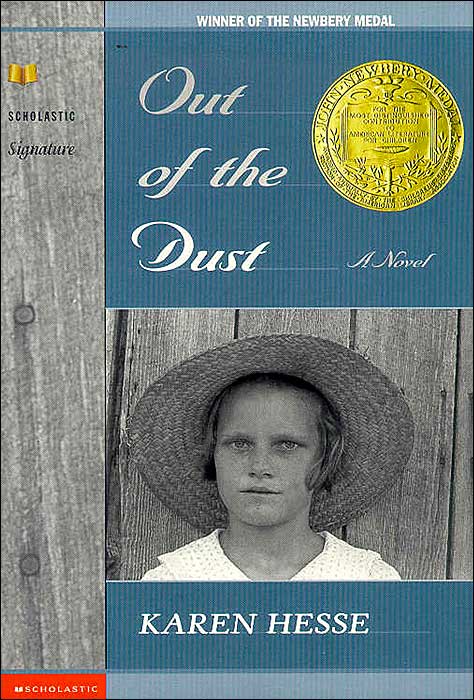
Karen Hesse's Out of the Dust won a Newberry Medal that same year. You can sample the verse-novel experience by searching for this book at Google Books .

The reason this article caught my attention is because my summer reading has begun with Vanishing Point by David Markson, a novel described as experimental fiction. Unlike Out of the Dust, it's not free verse, but more of a fragmented, non-linear narration. Take a look at a page or two.

Are you familiar with Google Books? Besides being able to preview pages of books, you can search for any term inside. For instance, Markson made some references about William Blake that I know I will want to come back to. By entering Blake in the search field, I'm able to look at any page with that word. Very convenient. The application also provides information about where I can buy the book, or find it in a library.

Up until now, free-verse novels haven't gone mainstream. Leave it to teens to show us what we've been missing.

Thursday, June 19, 2008

past and future books


Of all the children's books I've read, Madeleine L'Engle's A Wrinkle in Time, is the one I remember most fondly. I checked it out several times from my grade school library, and never tired of it. I can easily recall many of the books I loved as a child, and I know those experiences made me into the voracious life-long reader I am today.

I'm always interested to hear about books people enjoyed reading as children and teens, so when ReadWriteWeb provided a link to a forum where college-age 'kids' discuss their favorites, I rushed over. It's fascinating: L'Engle's book is mentioned, as well as Dr. Suess and Shel Silverstein, two more of my favorites authors.

One of the responders wrote that she still picks up her favorite children's books when she's feeling blue. Everything old is new again. Or, it never went out of style in the first place.

Leave a comment telling us about your favorite children's books.

Related post
book list: the game